Narrative Capital (YouTube Thumbnail) (2)

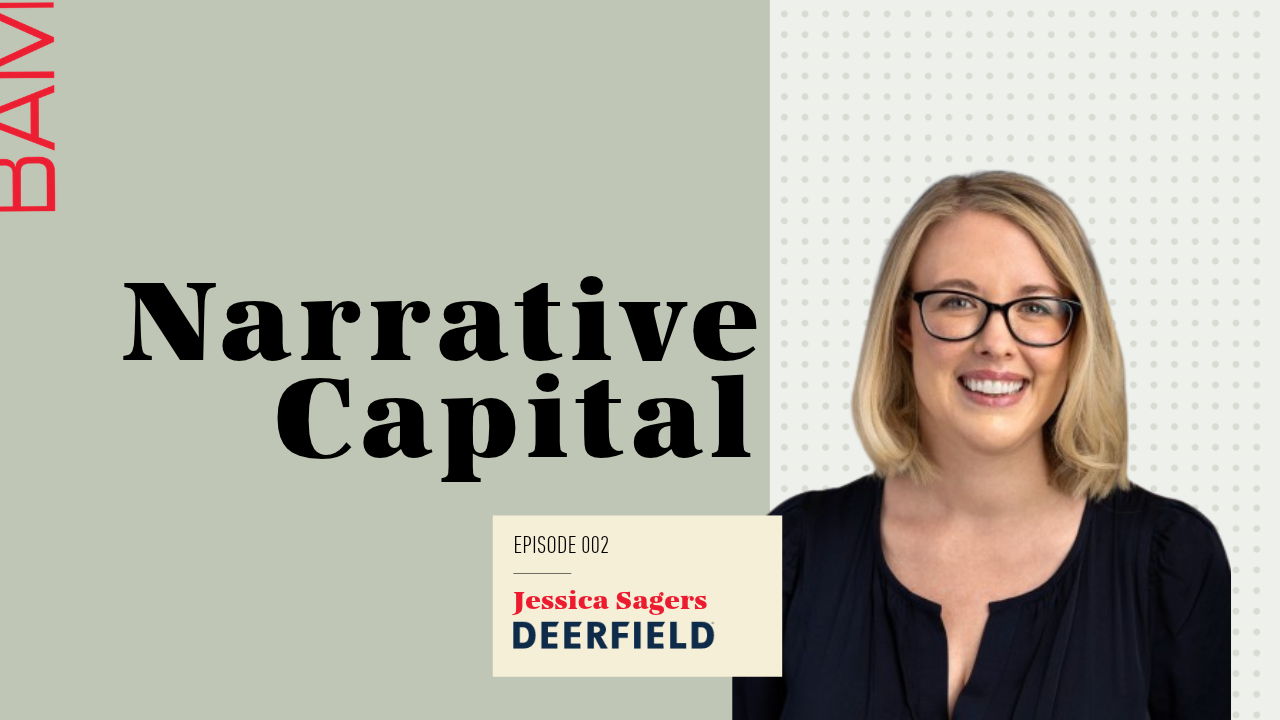
Narrative Capital: Jessica Sagers, Deerfield

In this episode of Narrative Capital, a podcast from the BAM Network, host Beck Bamberger sits down with Jessica Sagers, Head of Communications at Deerfield, a New York-based healthcare investment firm. They explore the business value of a company’s story and how it shapes what investors, journalists, and the public understand about the work.

Jessica takes us inside Deerfield’s approach to investing, from its early-stage biopharma companies to its employee-led philanthropic work. She explains what people often miss about why big pharma buys smaller companies, how founders can communicate the promise of their science without getting ahead of the evidence, and what first-person stories bring to healthcare journalism.

It’s a conversation about telling the story of science that’s still unfolding and giving people a reason to care about what happens next.

 

show notes:

00:00 - Deerfield Foundation's philanthropic mission

04:45 - Experience in therapeutics vs. tech

07:29 - Biopharma mergers and acquisitions

10:03 - Discussing health insurance frustrations

13:50 - Drug efficacy and market impact

17:44 - Crafting a compelling value proposition

20:54 - Improving presentation aesthetics


Read More About The Episode:


00:00 — How the Deerfield Foundation Supports Underserved Patients
Jessica Sagers, Head of Communications at Deerfield, introduces the healthcare investment firm and its employee-led foundation. She explains how the foundation uses grants and volunteer work to support children, families, and people living with rare diseases, including projects that can be difficult to fund through traditional investment.

04:45 — How Communicating About Therapeutics Differs From Tech
Jessica explains why the audience for a new therapy is often scientists and clinicians. She walks through how a drug moves from an idea to clinical trials and why the evidence it generates matters for both the scientific community and regulators.

07:29 — Why Big Pharma Acquires Smaller Biotech Companies
Jessica explains how early-stage biotech companies and large pharmaceutical firms take on different parts of drug development. She discusses why an acquisition can help move a promising therapy forward as the work becomes more expensive and complex.

10:03 — Why Health Insurance and Drug Costs Frustrate Patients
Beck and Jessica discuss how insurers, drugmakers, and distributors all shape what patients pay and which treatments they can access. Jessica points to STAT reporter Jason Mast’s coverage of Duchenne muscular dystrophy as an example of reporting that shows what drug decisions mean for patients and families.

13:50 — How Drug Efficacy Shapes Market Potential
Jessica explains how a drug’s potential market depends on the benefit it can deliver for patients. She shares the questions investors ask about a promising therapy, including what it could be worth if it works, how likely it is to succeed, and what it will take to reach the next milestone.

17:44 — How Biotech Founders Can Make a Clear Case for Investment
Jessica explains how founders can use familiar market examples to help investors understand what they’re building and where it fits. She discusses how to make the pitch specific by showing what sets the therapy apart and which milestone could change how investors value the company.

20:54 — How Better Visuals Can Make Biotech Pitches Clearer
Jessica discusses how founders can go beyond the standard PowerPoint deck to make complex science easier to follow. She points to molecular animations as one way to show how a therapy works and help people outside the field understand why it matters.

Narrative Capital: Jessica Sagers, Deerfield

In this episode of Narrative Capital, a podcast from the BAM...

Narrative Capital: Jennifer Solomon, NVP Capital

Welcome to Narrative Capital, part of the BAM Podcast Networ...